
WADS 205 – Dew Point Sensor
WADS 205 – Dew Point Monitor for Compressed Air
Dew Point Sensor WADS 205
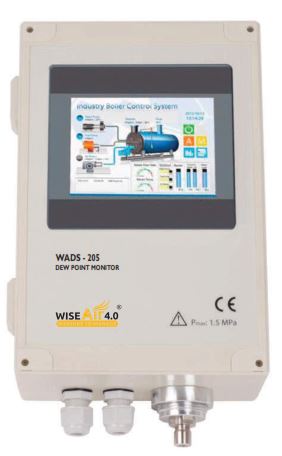
WADS 205 – Dew Point Monitor
Model Selector (WADS 205 / 206)
Use this selector to generate the correct ordering code based on pipe size and options.
The WADS 205 is a wall-mounted dew point monitor designed for continuous moisture monitoring in compressed-air systems. It provides plant engineers and operators with a local view of pressure dew point, making it practical for dryer rooms, plant utility areas and production environments where compressed-air quality needs to be checked during routine rounds. The wall-mounted design allows the reading to be viewed directly without opening a control panel or relying on a remote dashboard.
Moisture in compressed air can affect downstream filters, pneumatic equipment and product quality, while a change in dew point can indicate reduced dryer performance. The WADS 205 helps maintenance teams monitor these changes continuously. Available models cover dew point ranges from -110°Ctd to +60°Ctd, with accuracy up to ±2°Ctd, allowing the appropriate configuration to be selected according to the plant’s moisture-monitoring requirements.
How Does the WADS 205 Support Moisture Monitoring in Compressed Air?
The WADS 205 combines dew point measurement with an integrated MEMS-based pressure sensor in selected configurations. Measuring line pressure along with dew point helps engineers assess the actual pressure dew point rather than relying on an assumed operating pressure. This is particularly useful when monitoring compressed-air dryers, where changes in pressure and moisture conditions need to be considered together. To see how a reading relates to your line pressure, you can use the compressed air pressure dew point calculator.
For maintenance teams, continuous moisture monitoring in compressed air provides an early indication of changes in dryer performance before moisture becomes a visible problem downstream. The available options can provide local indication and alarm functions, allowing operators to respond when the measured dew point moves outside the required operating condition. This makes the WADS 205 suitable for plants where the reading needs to be visible and actionable at the point of monitoring. For occasional checks at other points in the system, a portable dew point meter can complement a fixed monitor.
Product Description
What Measurement Range and Accuracy Does the WADS 205 Offer?
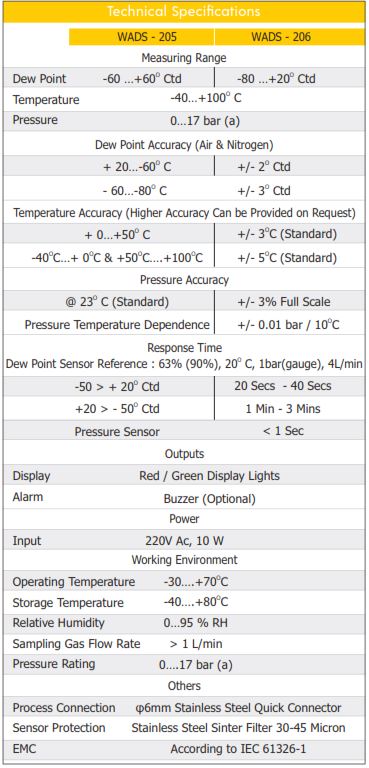
The WADS 205 and WADS 206 models are available across a wide range of dew point measurement requirements, with the series covering values from -110°Ctd to +60°Ctd. Specific measurement ranges can be selected through the model selector based on the required application. For compressed-air systems, this allows engineers to choose a suitable range for general plant monitoring as well as applications requiring lower dew point measurement.
The WADS 205 is specified with an accuracy of ±2°Ctd and uses multi-point temperature compensation to maintain measurement performance across its operating range. The integrated MEMS-based pressure sensor can also provide online pressure measurement in applicable configurations, with an absolute pressure range of 1–17 bar. These specifications allow the instrument to monitor both moisture condition and pressure where the application requires both measurements. If you prefer a transmitter format for installation in the line, consider the dew point transmitter for compressed air.
How Can the WADS 205 Help Prevent Moisture-Related Problems?
The WADS 205 provides continuous pressure dew point monitoring so maintenance teams can identify changes in compressed-air moisture conditions before they lead to downstream problems. A rising dew point can indicate that a refrigerated or desiccant dryer is not operating as expected. Detecting this change early gives engineers an opportunity to inspect the dryer and take corrective action before excess moisture reaches filters, pneumatic equipment or production processes.
Continuous monitoring can also reduce the need to depend only on periodic manual checks. The WADS 205 can be positioned where operators and maintenance personnel can see the reading during routine plant rounds, while available alarm options can provide a local warning when the dew point moves outside the required condition. This supports more consistent compressed-air quality, helps protect downstream components and can reduce maintenance caused by moisture-related issues. It is a good fit for regulated production areas such as those covered in our guide to compressed air monitoring for pharmaceutical plants, and for filling and packing lines described in compressed air monitoring for food and beverage plants.
Applications of WADS 205 Dew Point Monitor
The WADS 205 is suitable for continuous dew point monitoring in compressed-air systems where moisture control is important for reliable plant operation. In Pharmaceutical Plants, it can help maintenance teams monitor compressed-air quality, identify changes in dryer performance and reduce the risk of moisture affecting suitable downstream equipment and processes.
In Food & Beverage Plants, the WADS 205 can be used to monitor pressure dew point in compressed-air systems serving production and utility areas. Continuous monitoring helps operators identify changes in moisture conditions early, allowing dryer performance to be checked before excess moisture reaches filters, pneumatic equipment or other downstream applications.
Key Features
- Wall Mounting Casing Confirming to IP 65 Standards
- Are Available in a Wide Range of Models to Measure PDP from -110 Ctd to + 60 Ctd
- MEMS Based Pressure Sensor for Simultaneous Monitoring of Dew Point and Online Pressure (Absolute Pressure 1 … 17 Bar)
- Accurate to +/-2 Ctd with up to 9 Dew Point Calibration and Multi-point Temperature Compensation
- Ultra-fast Response
- Excellent Long-term Stability
- Innovative Anti-condensation, Particle, Oil and Most Chemicals Technology
- High Resistance to Electrical Disturbance
- CE marked in accordance with applicable EU Directives.
Declaration of Conformity available upon request.
Benefits
- Reduces Operating and Energy Costs
- Improves Down Stream Filter Life and Performance
- Increase the lifespan of your compressed air system and it’s components
- Reduces Maintenance and Makes the compressed air system more Reliable & Efficient.
- Ensures stable quality of your products through less problems in operation of the system
- Enables fast responses to failures in compressed air drying through permanent monitoring of pressure dew point. Reduces Risk of Bacteria, Fungus and yeast Build Up.
- Alerts you to changes in Dryer Performance Before Moisture Appears in Your Plant.
Related Case Studies & Blogs
Case Study: Why Dew Point Measurement is Important
Learn why monitoring dew point in compressed air systems is critical for product quality, energy savings, and equipment protection.
Case Study: Reducing Costs in Your Compressed Air System
See how dew point sensors helped identify moisture issues and reduce maintenance costs in a steel manufacturing plant.
How Compressed Air Monitoring Pays for Itself
A real-world case study showing the ROI of implementing compressed air monitoring with dew point sensors in manufacturing facilities.
Need this for your plant?
Send us your line size, operating pressure and flow range and a WiseAir application engineer will confirm the right model, the delivery time and the price. We manufacture in India, so lead times are weeks rather than months.
Prefer to talk? Call +91 90477 78715 or +91 98944 49015. Not sure it is the right instrument? A compressed air audit tells you what to measure and where. Or start with our free compressed air calculators.
Related Products
More Dew Point Sensors
Explore Other Solutions
WISEAIR TECHNOLOGIES INDIA LLP
# 12 Sri Venkatalakshmi Nagar, Singanallur,
Coimbatore – 641005 India.

WiseAir Technologies India LLP is part of the Systel Asia group — specialists in compressed air management and smart monitoring solutions across Asia since 2002.
© Copyright 2026. WiseAir Technologies India LLP
Need this for your plant?
Send us your line size, operating pressure and flow range and a WiseAir application engineer will confirm the right model, the delivery time and the price. We manufacture in India, so lead times are weeks rather than months.
Prefer to talk? Call +91 90477 78715 or +91 98944 49015. Not sure it is the right instrument? A compressed air audit tells you what to measure and where. Or start with our free compressed air calculators.